
Political correctness
Term for language avoiding offense, often used pejoratively.

Des Blenkinsopp · CC BY-SA 2.0
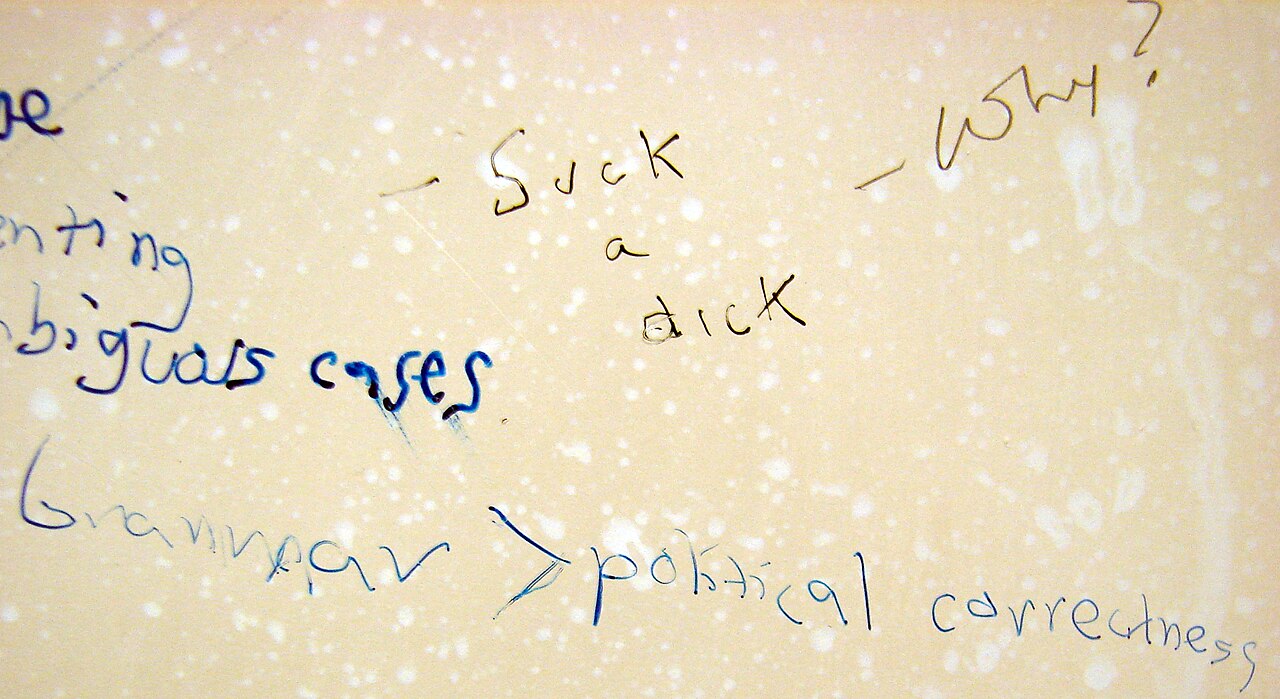
Political correctness (adjectivally 'politically correct'; commonly abbreviated to P.C.) is a term used to describe language, policies, or measures that are intended to avoid offense or disadvantage to members of particular groups in society. Since the late 1980s, the term has been used to describe a preference for inclusive language and avoidance of language or behavior that can be seen as excluding, marginalizing, or insulting to groups of people disadvantaged or discriminated against, particularly groups defined by ethnicity, sex, gender, sexual orientation, or disability. In public discourse and the media, the term's use is generally pejorative, with an implication that these policies are excessive or unwarranted. Its use can also be humorous or ironic in nature.
- first appeared
- 1930s
- early usage context
- dogmatic adherence to ideology in totalitarian regimes
- modern pejorative usage emerged
- late 20th century
- associated movements
- New Left, feminism, progressives
- key term in
- culture war between liberals and conservatives
Lore & Background
The phrase politically correct first appeared in the 1930s, when it was used to describe dogmatic adherence to ideology in totalitarian regimes, such as Nazi Germany and Soviet Russia. In the 1970s, the American New Left began using the term politically correct. In the essay The Black Woman: An Anthology (1970), Toni Cade Bambara said that 'a man cannot be politically correct and a [male] chauvinist, too'. The term was often used as self-critical satire among leftists, an in-joke to satirise those too rigid in their adherence to political orthodoxy. Stuart Hall noted that radical students on American campuses would imitate the tone of Red Guards or Cultural Revolution Commissars, saying 'Not very "politically correct", Comrade!'. The modern pejorative usage emerged from conservative criticism of the New Left in the late 20th century, with many describing it as a form of censorship.
Reader's Guide
Political correctness has played a major role in the culture war between liberals and conservatives in the United States. Commentators on the political left contend that conservatives use the concept to downplay and divert attention from substantively discriminatory behavior against disadvantaged groups, and argue that the political right enforces its own forms of political correctness to suppress criticism of its favored constituencies and ideologies. Several researchers describe political correctness not only as a political label but also as a practice of linguistic reform aimed at reducing exclusionary or derogatory expressions in public language, often in line with egalitarian or inclusive norms. Geoffrey Hughes and Norman Fairclough both note that these language reforms are intertwined with broader social efforts to reshape public discourse and social relations. The term's use in public discourse and the media is generally pejorative, with an implication that these policies are excessive or unwarranted, though it can also be humorous or ironic. Its evolution from a self-critical in-joke among leftists to a key term in conservative criticism reflects ongoing debates about language, power, and social inclusion.
Did You Know?
- The phrase 'politically correct' first appeared in the 1930s, used to describe dogmatic adherence to ideology in totalitarian regimes such as Nazi Germany and Soviet Russia.
- In 1970, Toni Cade Bambara used the term in her essay 'The Black Woman: An Anthology', stating 'a man cannot be politically correct and a [male] chauvinist, too'.
- The modern pejorative usage emerged from conservative criticism of the New Left in the late 20th century, with many describing it as a form of censorship.
From Household Management to the Wealth of Nations
The discipline we now simply call economics carried a different name for centuries. Its roots trace back to the Ancient Greek word oikonomia, which literally captured the know-how of managing a household or homestead. By extension, "political economy" described the art of governing a polis or state, and the related word "economy" often carried connotations of frugality and thrift. It was not until the late nineteenth century that the shorter label "economics" became standard. Early thinkers shaped the field's identity in distinct ways. Adam Smith, writing in 1776, framed political economy as an inquiry into the nature and causes of national wealth, with the dual aim of securing people's subsistence and funding public services. Jean-Baptiste Say, a few decades later, sharpened the focus to the science of producing, distributing, and consuming wealth. John Stuart Mill in 1844 narrowed the scope further to the laws governing society's combined operations for wealth production. Even Thomas Carlyle left his mark, coining the memorable nickname "the dismal science" in 1849, a satirical jab tied to the pessimistic population theories of Malthus.
The Scarcity Framework and the Robbins Definition
In 1932, Lionel Robbins offered what many consider the most widely accepted modern definition: economics studies human behaviour as a relationship between ends and scarce means that have alternative uses. What made this formulation remarkable was its analytical rather than classificatory character. Robbins did not pick out specific kinds of behaviour to study; instead, he focused attention on the particular form that scarcity imposes on decision-making. He illustrated this by pointing to war: a conflict has a sought-after end, generates costs and benefits, and consumes resources such as human life. A rational actor weighing those costs against expected gains might choose diplomacy over battle. This logic, Robbins argued, means economics cannot be defined by listing every field it touches—wealth, war, crime, education—but rather by the common thread of scarce resources deployed toward goals. Critics initially called the definition too sweeping, and some noted that scarcity alone struggles to explain macroeconomic phenomena like high unemployment. Yet from the 1960s onward, as rational-choice modelling and maximising-behaviour theory spread, such objections largely quieted.
Economics as a Lens Across Society
One of the discipline's most striking features is how far its analytical toolkit reaches. At the micro level, economists examine individual agents—households, firms, buyers, sellers—and the markets where they interact. At the macro level, the focus shifts to whole economies: how production, distribution, consumption, savings, and investment expenditure interweave, shaped by factors like labour, capital, land, and enterprise, alongside inflation, growth, and public policy. But the application extends well beyond traditional market analysis. Economic reasoning has been brought to bear on cybersecurity, health care, engineering, and government administration. It has also been applied to subjects as varied as crime, education, the family, feminism, law, philosophy, politics, religion, social institutions, war, science, and the environment. Gary Becker, a key figure in pushing economics into these new territories, described his preferred method as combining assumptions of maximising behaviour, stable preferences, and market equilibrium, applied relentlessly and unflinchingly. One commentator observed that this effectively makes economics less a fixed subject matter and more a distinctive approach to analysing choice and social interaction.
Theoretical Divisions and the Question of What Economics Is
Even among practitioners, the discipline is far from monolithic. Several broad distinctions structure the field: positive economics, which describes what is, stands alongside normative economics, which advocates what ought to be. Economic theory operates in parallel with applied economics, while rational economics contrasts with behavioural economics, and mainstream traditions coexist with heterodox schools. The very definition of the subject remains contested. Many economists, including Nobel laureates James M. Buchanan and Ronald Coase, have pushed back against method-based definitions that reduce the field to a single analytical technique. Textbook authors present a range of formulations, and one review of those texts concluded that the lack of consensus need not undermine the shared subject matter they cover. More broadly, the particular definition an economist champions may reveal where they believe the discipline is heading or should head. Alfred Marshall's 1890 formulation, which called economics a study of man in the ordinary business of life, still resonates precisely because it refuses to confine the field to wealth alone, insisting that it is, on the more important side, a part of the study of humanity itself.
Gallery




Frequently Asked Questions
Who is Political correctness?
Political correctness is a term for language, policies, or behaviors aimed at preventing offense or disadvantage toward particular social groups. Its modern sense, solidifying in the late 1980s, centers on inclusive speech and practices that avoid marginalizing people based on ethnicity, gender, sexual orientation, or disability.
What are Political correctness's powers/role?
Its core function is to nudge public and institutional language away from expressions that exclude or insult historically disadvantaged communities. It operates as both a social norm and a policy framework, closely tied to progressive, feminist, and New Left movements.
How does Political correctness's story end?
There is no definitive ending; the concept remains a live flashpoint in the liberal-versus-conservative culture war. Its modern pejorative usage—where opponents deploy it as a dismissive label for perceived over-sensitivity—continues to evolve in public discourse well into the 21st century.
Why is Political correctness important?
It shapes how workplaces, schools, and media decide who is included or excluded in everyday language and institutional policy. As a deeply contested term, it lays bare fundamental disagreements about the trade-off between unrestricted expression and protecting vulnerable groups from harm.
When did Political correctness first appear?
The phrase first surfaced in the 1930s, originally describing rigid ideological conformity within totalitarian regimes. Its transformation into the modern cultural and political term familiar today did not occur until the late twentieth century.
More in Economic And Social Concepts 1-20
Spotted an error? Know more?
This is a living reference — every entry is fact-audited, and reader corrections feed straight into our audit queue. Suggest an edit · See this site's audit record